

Introduction to the Davies Diaries Project
From Personal Record to Public Document
Robertson Davies (1913 to 1995), undertook to keep a diary in 1933, at the age of nineteen. Initially, his aims were modest, and personal. 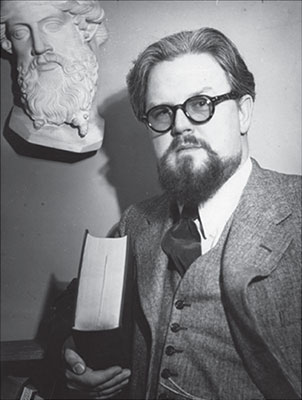
The most difficult thing about a diary is to refrain from imitating Pepys. Most diarists cherish the hope that their wretched books will be read when they are dead. I think I will make mine a frank diary so that I will be afraid to show it to anyone. (January 1, 1933)
As the compulsion to diarize took hold, this personal exercise expanded into a literary project that would occupy Davies for the rest of his adult life. His final entry was dated October 23, 1995, just five weeks and five days before his death at age eighty-two.
Over this sixty-two-year span, Davies’s own life experiences—as man of letters, novelist, playwright, newspaper editor, and founding Master of Massey College in the University of Toronto—gave him a privileged view of the inner workings of important sectors of Canadian society. His diaries’ scope expanded accordingly, to cover a wide swath of observations on matters social, cultural and educational. Their personal nature, however, was never compromised. The author’s character remains prominent, and the light Davies sheds on himself is often revealing, occasionally less than flattering, at times as frank as he had initially hoped it would be. By the latter part of his life, however, he was no longer reluctant to show his diary to others.
For when he arranged to have his diaries deposited with Library and Archives Canada, he must have cherished the hope, however faint, that his “wretched books” would be read by someone after he was gone. As he prepared this transfer of his private papers to the country’s public repository, his wife Brenda (referred to throughout the diaries simply as “B”) encouraged him to see their public value. “B says my diaries are the stuff of which social history is made, and I cannot imagine that Canada has an embarrassment of such material.” (November 9, 1992)
Organization
As the scope of the diaries expanded, their organization became more complex. In 1958 Davies decided to keep a record of his playgoing experiences, separate from the more general account of his personal life. In the same year, he took to recording his frequent travels in another set of diaries. And in 1961, sensing that his role as the founding Master of Massey College would give him a unique vantage point from which to observe the beginnings and early years of a major educational institution, he began the Massey College diaries, which he would keep faithfully until his retirement from the position of Master in 1981.
There are, then, four different sets of diaries—Personal, Theatre, Travel, Massey College—all of which overlap with one another to some degree. To these must be added a fifth category, the small, leather-bound appointment books, or daily agendas, in which Davies organized his multitudinous appointments and obligations, but in which he sometimes recorded as well the content of his dreams or personal reflections on the events of the day. In some years, these appointment books constitute the only personal diary that he kept; in others, they are a separate, parallel record, with which the personal diaries for the year can be compared.
The Davies Diaries Project duplicates in presentation this complicated and sometimes shifting organizational structure, imposed by Davies on the record of his life. However, the website’s own underlying file structure, organized first by diary type and then by calendar year, enables readers who wish to follow a strictly chronological path through the material, to do so.
Presentation
The Davies Diaries Project makes use of the Digital Page Reader, especially designed for the digital edition of the complete works of P.K.Page. This Reader allows the user to view transcriptions of Davies’s diary entries side-by-side with images of the manuscript pages on which the transcriptions are based. Where these manuscripts show evidence of later revisions, the revisions are presented in a clear and concise manner, avoiding esoteric symbols and abbreviations, and each point in the transcription is linked to the equivalent point in the manuscript image. In other words, at each point, the reader can check the map against the territory. (Reproduced, with permission and with some modifications, from the website of the Digital Page at digitalpage.ca.)